Jutting out into Sydney Harbour, historic Balmain and Birchgrove offer one of the Inner West’s most captivating urban trails. While the area is famous today for its sandstone pubs, leafy avenues, and prime waterfront real estate, its character was forged as a bustling industrial powerhouse. Exploring this peninsula on foot reveals a seamless blend of working-class maritime history, reclaimed foreshore parklands, and front-row harbour views that prove you don't need to head for the national parks to find a great walk.
Balmain & Birchgrove
📍 SYDNEY AND SURROUNDS
Distance10.1 km
Duration03:53 hrs
Elev Gain+229 m
Elev Lost-204 m
Date
28 August 2021
Starting Point
Bridgewater Park
Difficulty
Easy
Pace / Gear
2.7 km/h — Light day pack
Highlights
Snails Bay, Ballast Point Park, Mort Bay, Ewenton Park
🗺️ Interactive Route MapPinch or use wheel to zoom
Lockdown may have shrunk our world to our immediate local area, but forced local exploration has its silver linings. Tucked away in Sydney’s Inner West, historic Balmain proves you don't need to head for the national parks to find a brilliant walk—weaving together deep maritime history, grand Victorian streetscapes, and sweeping harbour views right on our doorstep.
From the 1840s onwards, Balmain transformed almost overnight from a quiet rural retreat into a bustling industrial powerhouse as shipyards, engineering works, and coal mines took over the foreshore. Today, as one of Sydney’s oldest suburbs, much of the peninsula is protected as a conservation area—preserving a remarkably intact streetscape of sandstone pubs, narrow worker’s cottages, and rich maritime heritage.
We drove the short distance to Iron Cove Bridge, which spans one of the Inner West’s most popular harbour bays. Having explored the cove during a previous lockdown, continuing onwards into Balmain felt like a natural extension. We parked in the backstreets nearby and made our way down to the water’s edge to start the route.
Iron Cove Bridge at the entrance to Iron Cove
The shoreline path leads through Bridgewater Park into Balmain Cove Park—a quiet green space built on the site of the former Balmain Power Station. The heritage-listed brick pumphouse still stands by the water’s edge as a prominent nod to the area's heavy industrial past. At the far end of the park, the trail squeezes between waterfront tennis courts and the bay before weaving up into the quiet backstreets towards Sommerville Point.
Birkenhead Point – once warehousing, now a retail outlet
The old power station pumping house
Parramatta River
The park at Balmain Cove
Beyond the point lies Elkington Park, an elevated, tree-shaded reserve offering sweeping views across the inner harbour toward UNESCO World Heritage-listed Cockatoo Island. Operating between 1857 and 1991, Cockatoo was once home to one of Australia’s largest shipyards, with its earliest dry dock carved out by convict labour. Today, its remarkably preserved prison precinct forms part of a serial listing of eleven Australian Convict Sites scattered across the country.
A small area of remnant bush along the foreshore
White Horse Point
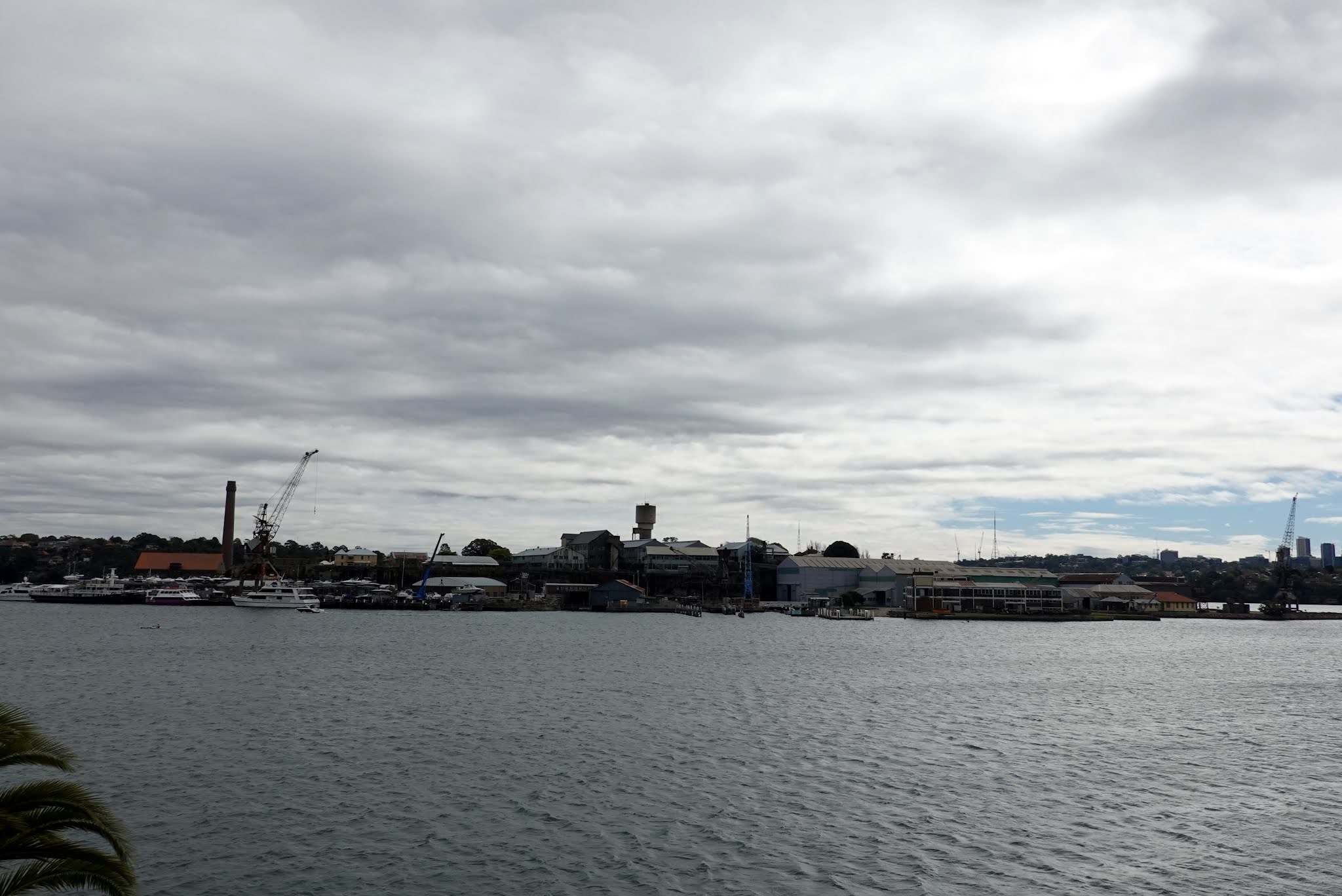
A gloomy Cockatoo Island
Elkington Park and the Dawn Fraser Baths
From there, we made our way onto Louisa Road in neighbouring Birchgrove—one of Sydney’s most sought-after strips of real estate. Running along the narrow spine of the peninsula, this iconic street has long been one of the city's most charming enclaves, lined with historic weatherboard cottages, grand colonial homes, and private waterfronts overlooking Snails Bay.
Birchgrove at Birchgrove Oval
Wharf Road
In the heart of Birchgrove is the sports oval, which backs onto Snail's Bay. Here you will find the tiniest of beaches and an impressive view of the Sydney Harbour Bridge.
Snails Bay
Sydney Harbour Bridge
Snails bay
Heading east along Wharf Road brings you to Ballast Point Park (also known as Walama)—a striking, multi-tiered green space reclaimed from a former Caltex fuel depot. Designed as a terraced maze of rusted-steel gabion walls, recycled concrete, and native plantings, it's a brilliant area to explore. The highlight is the tip of the point itself, which looks across the water toward the timber heritage of Waterview Wharf and the hyper-modern skyline of Barangaroo. The Sydney Harbour Bridge makes a guest appearance here too, though it remains partly framed behind Goat Island.
Ballast Point Park
View across Mort Bay
Goat Island
Waterview Wharf Workshops
Mort Bay
Ballast Point Park
Directly adjoining Ballast Point lies Mort Bay Park—another stellar example of post-industrial land reclaimed for the public. Originally known as Waterview Bay, the inlet was renamed after English-born industrialist Thomas Mort, who excavated Australia’s very first dry dock here in 1855. The shipyard grew into the colony’s largest private engineering works and played a crucial role in taking on major naval contracts during World War II. Today, the park retains plenty of subtle nods to its heavy industrial past, including the visible stone rim of the in-filled dry dock running through the lawn.
Mort Bay
Reaching Mort Bay gave us the perfect opportunity to pick up the trail of a self-guided heritage walking tour produced by the Inner West Council. The route highlights notable historic spots around East Balmain, starting down at Thames Street Wharf.
Down at Thames Street Wharf sits a charming piece of Sydney maritime history: a timber passenger shelter dating back to around 1902. Thought to be one of the last surviving turn-of-the-century ferry shelters on Sydney Harbour, it has been given a second life in recent years as a beloved, volunteer-run Street Library—allowing commuters and passersby to swap books by the water's edge.
The community library inside the old ferry wharf building
Following the digital map for the walking tour on our phones, we left Thames Street Wharf and made our way up toward Darling Street—East Balmain’s vibrant main drag. Turning off the main road brings you onto Colgate Avenue, and if you suspected a connection to the famous household brand, you’d be spot on. At the end of the street stand the beautifully preserved former Colgate-Palmolive factory buildings. Opening on the waterfront in 1923 to manufacture soap and toothpaste, the grand Art Deco complex operated for over 70 years before being converted into luxury residential apartments.
Colgate Avenue
The Colgate-Palmolive building
Waterfront access was the main drawcard for the company, allowing barges to deliver raw ingredients directly to Colgate’s private wharf. Within just two years of opening in 1923, the Balmain plant employed over 140 workers, manufacturing soap and toothpaste that quickly became household staples across Australia and New Zealand. After spending a few minutes admiring the grand brick facade—now stylishly redeveloped into residential apartments—we turned back toward the main road.
Colgate-Palmolive
Deciding we’d had our fill of history for the day, we set our sights on heading back to the car—making a quick detour through Ewenton Park along the way. Sitting right on the water, the park serves up a stunning, uninterrupted view of the Sydney city skyline. It takes its name from Ewenton, a magnificent 1850s Victorian sandstone mansion that still stands proudly on the hill overlooking the green.
The view of Darling Harbour and Sydney from Ewenton Park
Ewenton
Ewenton Park sits right beside White Bay, home to one of Sydney's secondary cruise terminals. Unlike Circular Quay's Overseas Passenger Terminal, White Bay caters to smaller-scale cruise ships and passenger liners—vessels compact enough to clear the harbour's bridges. Skirting around the perimeter of the port, we cut back up to Darling Street just in time to stop at a local café for lunch. Refuelled, we continued west along Balmain's main retail strip.
Darling Street leads up to the leafy expanse of Gladstone Park before intersecting with Beattie Street, which winds back through the heart of Balmain toward our car at Bridgewater Park. The foreshore of Balmain and Birchgrove is a fascinating place to explore, packed with hidden nooks and rich heritage highlights. The quiet, sought-after suburb we see today is vastly different from the smoky shipyards, coal mines, and soap factories of its industrial past—making it one of Sydney's most rewarding urban walks.
The London Hotel in Balmain
Centenary Hall
Beattie Street
Balancing sweeping harbour vistas with a rich tapestry of maritime heritage, this foreshore loop proves that great walking isn't reserved strictly for national parks. Balmain and Birchgrove offer a compelling urban trail that rewards curiosity at every turn—a quiet reminder that some of Sydney's most fascinating journeys are hiding right in our own backyards.




No comments :
Post a Comment