Showing posts with label mountains. Show all posts

Wednesday, 2 January 2019

Gear Roundup: Winter Walking

Winter Mountain Walking — Essential Gear & Preparation

As the nights draw in and weather forecasters start talking about 'snow on the tops', the high country transforms into an entirely different realm. Winter strips away the forgiving nature of the hills: a gentle summer stroll can quickly morph into a serious alpine test where weather, terrain, and margin for error shift dramatically within minutes.
The most reliable winter hiking in the UK is found in Scotland, with snow guaranteed between January and March. However, navigating Scottish winter conditions is a skill unto its own—warranting dedicated training. Having completed a winter skills course at the Plas y Brenin National Mountain Centre, I would recommend it to anyone considering taking their fell-walking into the fourth season.

⏱️ Winter Kit Essentials at a Glance

  • Pack: 35-45L capacity for extra bulk and fast packing in cold conditions
  • Technical Tools: T-rated walking axe (ankle-length shaft) & C2/C1 crampons
  • Footwear: Stiff B1 or B2 rated winter boots (essential for crampon safety)
  • Navigation: Laminated OS map pre-marked with bearings & magnetic compass
  • Warmth & Protection: 3-layer system, synthetic belay jacket, ski goggles & 3-4 pairs of gloves
  • Safety: Whistle, high-output torch with reactive beam, and survival shelter bag
The Langdale Pikes in winter
The dramatic, snow-dusted ridges of the Langdale Pikes

Pack & Navigation Strategy

I step up to a large 36-litre pack in the winter. Cold-weather gear is inherently bulkier, but there’s a vital practical reason for the extra volume: efficiency. A large pack means you can shove gear in quickly rather than fighting intricate packing arrangements—extremely useful when spindrift is flying and your fingers are cold.
Kit for a typical winter outing
Essential gear layout for a full day out in the mountains
Navigating in winter is a core element of staying safe. A map and compass are non-negotiable. Pre-calculating route bearings onto your map saves you from precise, fiddly work in harsh conditions. Laminated OS maps are ideal for this, as you can write directly on them in chinagraph pencil and wipe them clean afterwards.

Axes, Crampons & Boot Compatibility

Walking in winter almost instantly conjures up thoughts of specialist gear, and none are more iconic than an ice axe. They provide invaluable stability on steep ground and offer a vital line of defence should you slip.
DMM Raptor Ice Axe
My DMM Raptor ice axe
Ice axes come with a 'B' (Basic) or 'T' (Technical) rating stamped onto the shaft. Both are fine for general walking, but I carry a 'T' rated axe—the extra mass makes it much easier to drive the pick cleanly into frozen turf and hard-packed snow. Ensure you select a straight or slightly curved walking axe sized so the spike hangs near your ankle when held at your side; short, aggressive climbing axes are designed for vertical ice walls and are awkward for general walking support.
The golden rule in winter is simple: don't fall over. One of the best ways to achieve this is by using a pair of crampons combined with solid footwork. Crucially, crampons must be paired with suitably stiff mountaineering boots (B1 or B2 rated). Attempting to strap crampons onto flexible summer walking boots is dangerous—the boot will flex underneath the rigid crampon bar, risking metal fatigue, snapped linking bars, or the crampon popping off completely mid-slope.
Black Diamond Serac crampons
Black Diamond Serac crampons paired with stiff winter boots

What may be a simple stroll in summer can become an absolute epic in winter.

Scafell and Scafell Pike
Majestic views over Scafell and Scafell Pike in full winter coat

Layering Systems & Waterproof Protection

Managing body temperature and moisture control is the key to surviving winter walking. The standard 3-layer system remains the gold standard, though modern technical fabrics offer incredible versatility across mid-layers and active insulation:
1. Base Layer: Wicks sweat away from the skin immediately. High-grade synthetic active mesh or technical merino wool works best to prevent the rapid cooling that occurs when you stop moving.
2. Mid-Layers & Active Insulation: Gridded fleeces and highly breathable synthetic jackets allow moisture to pass through while trapping vital body heat.
3. Hard Shell Waterproofs: A robust, fully seam-sealed hardshell jacket and over-trousers form your windproof and rainproof fortress. Heavy-duty 3-layer Gore-Tex or equivalent membranes are necessary to withstand the punishing combination of gale-force winds, driven sleet, and sharp ice.
4. Stationary Belay Layer: Having a warm over-jacket stored right at the top of your pack is non-negotiable. While down offers impressive warmth-to-weight, UK winters are wet and maritime—the moment down gets saturated by driving sleet or spindrift, it completely collapses and loses all insulation. For British fell-walking, synthetic insulation (such as PrimaLoft) is vastly superior, as it continues to trap heat even when damp.
Spindrift on Helm Crag
Spindrift whipping off the ridge at Helm Crag
Goggles might seem an odd addition at first, but when you're staring down 40-knot gusts of driving spindrift, you'll be glad you have them. I was once turned back from Helm Crag for precisely this reason. A basic pair around £20 is all it takes to keep you moving safely.
⚠️
Rule of Thumb: Glove Redundancy Always pack at least 3 to 4 pairs of gloves for an all-day winter walk. They get soaked quickly and can easily blow away in high winds. Carry thin liners, warm fleece mid-weights, heavy waterproof outers, and a dry spare set.
Array of winter gloves
A typical layered array of gloves
With daylight fading early, a high-output headtorch is essential. I carry a Petzl Tikka RXP for its reactive lighting technology, which adjusts brightness automatically and saves battery life in freezing conditions.
Panorama of Ribblesdale
Wide open winter views across Ribblesdale

Full Winter Gear List Breakdown

Category Equipment Choice Primary Function
Carrying 36L Mountaineering Pack High volume for bulky cold layers
Footwear B1 / B2 Rated Stiff Boots Essential rigid platform for crampon safety
Hard Shell Heavyweight 3-Layer Waterproofs Full wind and driven rain shield
Insulation Heavyweight Synthetic Belay Jacket Stationary warmth (retains loft when wet)
Hardware DMM Raptor Ice Axe (T-Rated) Ankle-length walking axe for balance & self-arrest
Traction Black Diamond Serac Crampons Frozen turf & hard snow grip
Lighting Petzl Tikka RXP + Alpkit Backup Reactive lighting for dark descents
Safety Blizzard Survival Bag & Whistle Emergency shelter & signalling
Eyewear Ventilated Ski Goggles Spindrift & whiteout vision protection
The rewards for lugging this extra gear are immense. Frozen landscapes, crisp alpine air, and solitude offer a grandeur that summer walking simply can't match. Is there anything you think I've missed from this list or a piece of kit you never leave home without in winter? Let me know in the comments below!

Sunday, 16 September 2018

The Scandale Horseshoe

The Scandale Horseshoe 15-09-2018

This map was created using GPS Visualizer's do-it-yourself geographic utilities.

Please wait while the map data loads...


Route: Ambleside, Cumbria University, Nook End Farm, Low Sweden Bridge, High Sweden Coppice, High Brock Crags, Low Pike, High Pike, Thack Bottom Edge, Dove Crag, Bakestones Moss, Little Hart Crag, Scandale Pass, Red Screes, Snarker Moss, Snarker Pike, Kirkstone Road, Ambleside

Date: 15/09/2018
From: Ambleside


Parking: Ambleside
Start Point: Ambleside
Region: Eastern Fells

Route length: 10 miles (16 km)
Time taken: 04:34
Average speed: 2.2mph
Ascent: 1,082m
Descent: 1,096m

Wainwrights on this walk:
Low Pike (508m), High Pike (656m), Dove Crag (792m), Little Hart Crag (637m), Red Screes (776m)

Additional summits: None

Other points of interest: Scandale Pass

I think today was the day that Autumn well and truly arrived, over the period of a couple of hours. The forecast for the weekend wasn't amazing but Saturday promised a decent, dry day of hiking. How wrong it turned out to be.

Scandale is the lesser neighbour of Rydal which, if you weren't aware, is the valley that is enclosed by the legendary Fairfield Horseshoe. While the western side of Scandale is very well-trodden (including Low Pike, High Pike and Dove Crag) the eastern arm is much less frequented.

The walk begins from Ambleside where I was lucky enough to bag a parking space at the local school, which kindly offers their parking spaces at the weekends for a small donation. This was after being dismayed to find that my usual spot, along Under Loughrigg, had been unceremoniously double-yellowed since my last visit.
Bridge House in Ambleside
If you are familiar with the classic anticlockwise Fairfield Horseshoe, then this walk begins in the opposite direction, winding through Ambleside to Nook Lane and passing the University of Cumbria (their Ambleside operation at least) until Nook Lane terminates at Nook End Farm. Here, the path heads through a gate onto the open fells.
Scandale Beck at Low Sweden Bridge
Rydal and Nab Scar
Blue skies over Windermere
The path climbs along a stony track before I took a deviation to begin climbing Low Pike, following the famous drystone wall that runs along the ridge's crest all the way to Hart Crag. While it makes navigation easy, it blocks much of the view to the west. Some minor but interesting scrambling is required at Low and High Brock Crags before the final pull up to Low Pike.
The undulating beginnings of the ridge
Add caption
Entering the Access Land at High Sweden Coppice
Sweden Crag
Low Pike and High Pike
The famed drystone wall
Ambleside and Windermere
Low Pike's summit
High Pike stands around a kilometre away from Low Pike with a 150m difference in elevation. Once across the shallow depression between them, the path leads directly to the summit. The sun was threatening to come out - always a good sign in the Lake District, however, things were also looking a little grey away to the south. The battle was on.
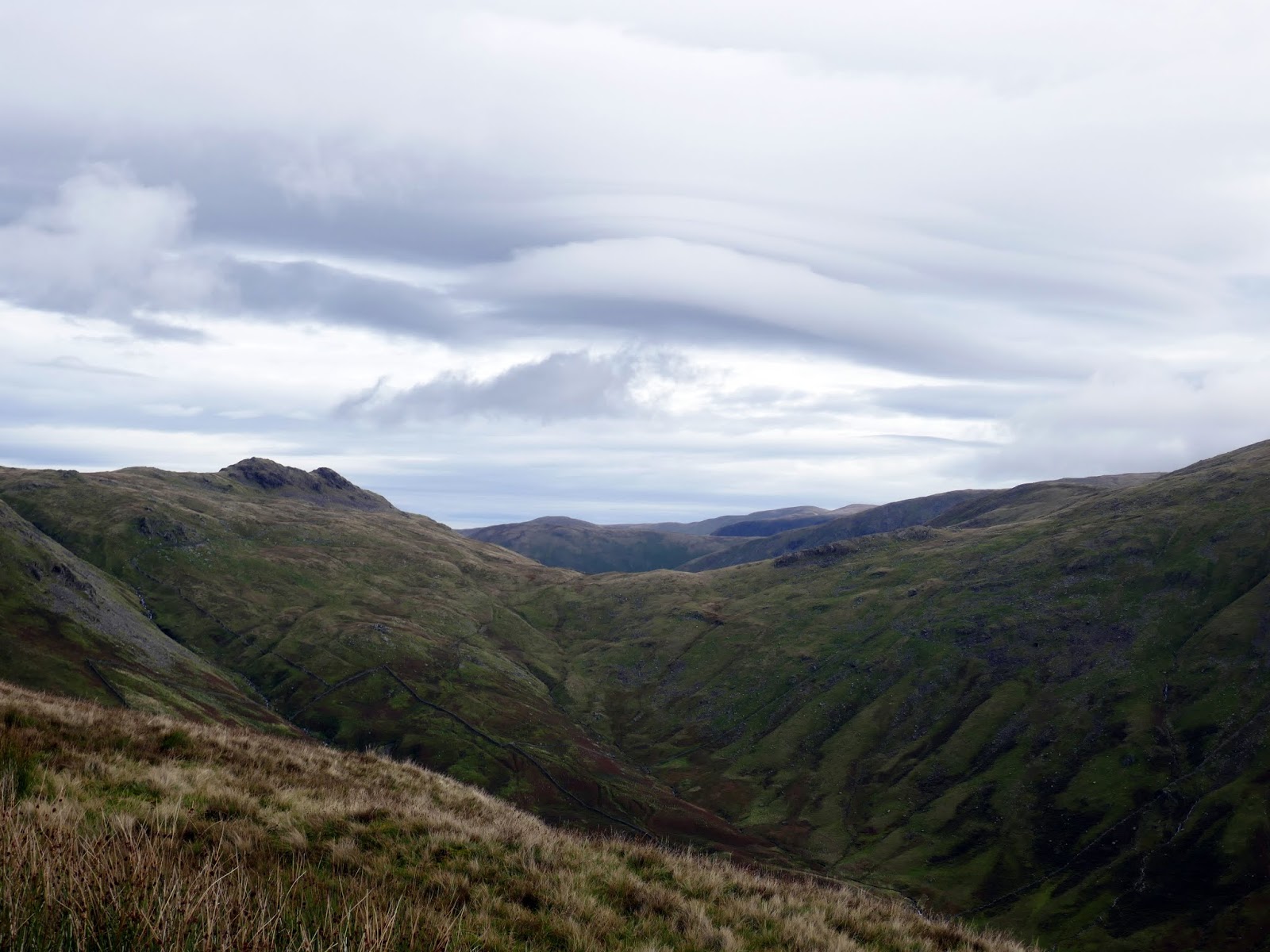
Scandale
The route to High Pike from Low Pike
High Pike
Looking back to Low Pike
High Pike
Little Hart Crag
Cloud forms over the Eastern Fells
Ambleside and Windermere over Low Pike
The summit of High Pike
Once across High Pike, the path continues its climb up the easy grassy slopes of Dove Crag, the first fell to documented in Wainwright's legendary series. While the true horseshoe route bypasses the summit, it would have been rude not to pay it a quick visit.
Scandale
Little Hart Crag
Dove Crag
The wall continues to Dove Crag's summit
Sunshine in the eastern fells
The cairn on Dove Crag
Retracing my steps slightly, a steep descend drops you into Bakestones Moss between Dove Crag and Little Hart Crag at the head of Scandale. The prospect of a sunny afternoon was becoming more and more diminished as the ominous grey skies swept over Coniston and Windermere, heading in my direction. At Little Hart Crag I opted to avoid a prolonged lunch break, instead, donning my waterproofs in preparation.
Little Hart Crag and Red Screes
Cloud and rain over Windermere
Hartsop above How and Dovedale
Hartsop above How
Little Hart Crag over Bakestones Moss
Red Screes
Scandale
Little Hart Crag 
By the time I had crossed Scandale Head the rain had arrived. It had been edging up the valley for a good half-hour which suggested it wasn't going to be leaving anytime soon. After taking a final couple of photos, I battened down the hatches and got my head down for the climb up Red Screes.
Red Screes and Scandale
Rain approaching
One last view of Red Screes
Clouds sweep over Scandale Pass
In the cloud and the rain, a long climb is fairly uninspiring. Other than a cursory glance at my GPS, there is no skyline to aim at or objective to look out for. It's a simple task of plodding on until the summit is reached. I was disappointed, primarily because the ridge from Red Screes to Snarker Pike and beyond is one of the few places I have never visited and it was going to be covered in cloud.
Red Screes summit
Red Screes is topped by a trig pillar and substantial shelter, which a couple of walkers were taking full advantage of. Slightly dispirited, I turned south to begin the long walk back towards Ambleside.
Somewhere near Snarker Pike
I was almost at the Kirstone Road by the time I had dropped out of the cloud, though that did mean I was approaching the end of the walk. Unfortunately, you have to walk along the road for a distance until the pavements of Ambleside are reached.
Emerging from the cloud
A look back up the ridge
The intake wall
Kirkstone Road
Having not really stopped at any point during the walk, I made it back to Ambleside in time to enjoy a coffee and cake and have a mooch around the shops - that's what you're supposed to do in Ambleside, isn't it? Memories of the Red Screes soaking quickly diminished, this is the Lake District, after all, we've just been spoiled by a superb summer.