

The Milford Track — The Finest Walk in the World
The Milford Track is widely regarded as New Zealand’s most iconic Great Walk, often celebrated as “the finest walk in the world” — a phrase first published in the London Spectator in 1908 and still used today due to the track’s extraordinary scenery and global reputation. This legendary four day, 53 km hike leads walkers deep into Fiordland National Park, one of New Zealand's most remote and dramatic wilderness regions and part of the Te Wāhipounamu UNESCO World Heritage Area.
When we visited Milford Sound in 2023, I was blown away by the scenery of Fiordland National Park. Hiking the Milford Track quickly became a bucket-list goal, and a couple of years later, I’ve finally put all the pieces together for the trip of a lifetime.
⏱️ Milford track Quick Summary
- Duration and Distance: 4 days, 53.5 km (33 miles).
- Route: Strictly one-way (South to North). Begins with a boat ride from Te Anau Downs to Glade Wharf, and finishes at Sandfly Point.
- Scenery: Towering mountains, massive waterfalls, dramatic alpine vistas.

|
| Milford Sound on a beautiful sunny morning |

|
| Milford Sound when we visited in 2023 - full of drama |
Location
The Milford Track is located in Fiordland National Park on New Zealand’s South Island. Fiordland is one of New Zealand’s largest and most remote protected areas, covering vast tracts of rainforest, alpine ranges and deeply carved glacial valleys. Shaped by ice, rain and time, it’s a landscape defined by steep rock walls, fast-flowing rivers and an almost constant presence of water; whether that's cascading down waterfalls or falling from the sky.
Places like the upper Clinton Valley near Mintaro Hut show Fiordland at its most dramatic, but Milford Sound is the jewel in the crown.
Distance, Duration, and Difficulty
The Milford Track is modest by long-distance hike standards, clocking in at 53.5 km (33.2 miles). The one-way hike is completed over four days / three nights during the Great Walks season.
Difficulty is subjective; experienced hikers may find it relatively easy, while some may find it pushes their boundaries. It is generally described as 'intermediate' — the valley sections are largely flat while the crossing of McKinnon Pass can be a challenge, with 600m of ascent and 900m of descent in the day, accompanied by the potential for difficult weather.
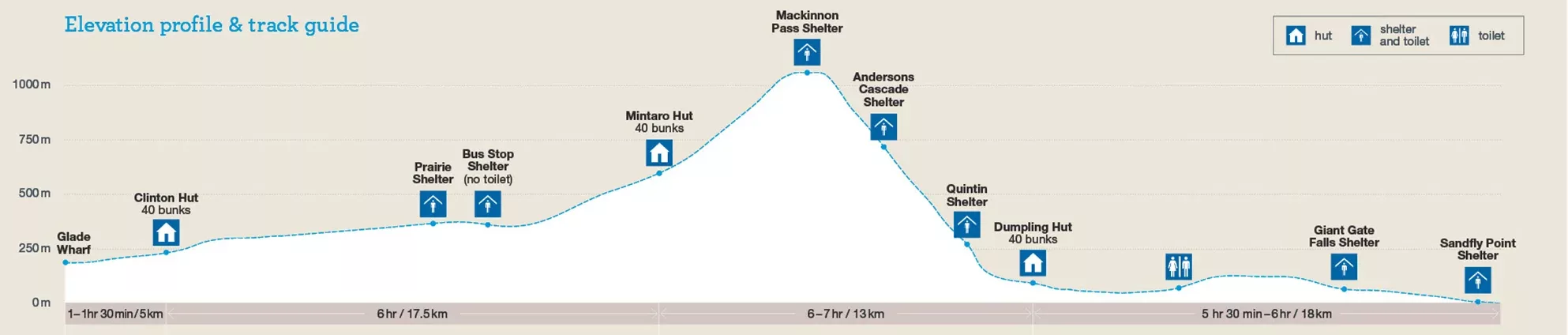
Track Layout and Daily Stages
The Milford Track allows no directional flexibility; it must strictly be hiked in one direction from south to north. Every hiker begins the journey at Glade Wharf (reached via boat from Te Anau Downs) and finishes at Sandfly Point (followed by a short boat shuttle into Milford Sound
The daily staging for the Milford Track depends entirely on whether you are tackling it independently or as part of a guided experience. Guided tours operate their own luxury, private lodges completely separate from the Department of Conservation (DOC) huts
The solo experience (unguided) strictly takes four days and three nights due to mandatory, fixed hut-booking regulations, operating on the following itinerary:
- Day 1 - Glade Wharf to Clinton Hut (5 km)
- Day 2 - Clinton Hut to Mintaro Hut (16.5 km)
- Day 3 - Mintaro Hut to Dumpling Hut, crossing McKinnon Pass (14 km)
- Day 4 - Dumpling Hut to Sandfly Point (18 km)
Booking
Hut bookings are required during the Great Walk season and are managed by New Zealand’s Department of Conservation (DOC). Numbers are capped to just 40 independent hikers per day, and popular dates sell out quickly (think summer holidays and public holidays). Typically, the allocation for the Milford Track can sell out in minutes due to extremely high demand. The DOC huts must be used as camping is not permitted on the Milford Track. Outside the Great Walks seasons, the huts are first-come, first-served and do not require bookings, but facilities are much reduced.
📅 Essential Booking Advice
- Create Your DOC Account Early: Set up your profile on the DOC booking portal *before* opening day. Do not waste precious seconds registering when slots go live.
- The Queue: Arrivals before opening time will be placed in a virtual queue. Do not refresh or close the tab—the system processes requests rapidly, and slots frequently open up as carts expire.
- Booking: Once you access the booking system, you will have 10 minutes to make your selections.
- Have Backup Dates Ready: Flexibility is your best asset. If your primary window is taken, instantly jump to your second or third preference without hesitation.
- Monitor for Cancellations: If you miss out, check the portal regularly in the following weeks. Slots occasionally reappear due to itinerary changes or uncompleted payments.

|
| The DOC owned Clinton Hut |

|
| DOC employ a queuing system for when Great Walk bookings go live |
I decided to make my life a little easier by booking a guided experience with Ultimate Hikes, the only company that offers the full, multi-day trip along the Milford Track. They often have more availability, but the costs are much higher. In fact, I went all in and booked The Classic; a combination of the Milford Track and the Routeburn Track; two of New Zealand's most popular Great Walks.

|
| Glade House operated by Ultimate Hikes |
Transport
During the Great Walks seasons, the Milford Track is hiked one-way from Glade Wharf to Sandfly Point / Milford Sound. Therefore, you will need to arrange transport to the beginning and from the end of the hike. This should be done after you have locked in your hut booking so you know exactly when and where you will be. Hut bookings with DOC have links to transport options while guided hikes include all necessary transfers.
The cost of transport will depend on where you start; a transfer from Queenstown can set you back around $350 NZD. This usually covers the "all-in" logistics (bus to Te Anau Downs, boat to Glade Wharf, and the return from Milford Sound) — Fiordland Outdoors is a popular operator.

|
| The water taxi from Sandfly Point runs fairly regularly during the Great Walks season, crossing the fiord in a matter of minutes. |
Weather and Why Rain Isn't a Bad Thing
Fiordland National Park is one of the wettest places on Earth, with Milford Sound seeing 6–7 metres of rain a year; it is wet or cloudy two-thirds of the year. Rain can slow progress, swell rivers, and obscure views, but it also turns the track into a living landscape — hundreds of waterfalls appear, valleys mist over, and the rainforest glows — making wet days on the Milford Track some of the most memorable. Expect to experience rain sometime during your hike.

|
| The cliffs come alive when it rains |

|
| Hineteawa / Bowen Falls |
Since the Milford Track is famous for its unpredictable weather and rugged terrain, having the right gear isn't just a matter of comfort — it's a matter of safety. While this guide covers the logistical "where" and "how" of the journey, I’ve put together a dedicated follow-up article that dives deep into my comprehensive gear choices.
From the specific waterproof layers that survived Fiordland’s torrential downpours to the lightweight essentials that kept my pack weight down over 53 kilometres, head on over here to check out my Milford Track Packing List to see the exact equipment I carried along with my top recommendations for staying comfortable and blister-free on the trail.

No comments :
Post a Comment