
This map was created using GPS Visualizer's do-it-yourself geographic utilities.
Please wait while the map data loads...
Route: Glade Wharf, Glade House
Date: 30/01/2026
From: Glade Wharf
Parking: N/A
Start Point: Glade Wharf
Finish Point: Glade House
Region: Fiordland National Park
Route length: 1.6 km
Time taken: 00:17
Average speed: 4.6 km/h
Ascent: 17m
Descent: 11m
Points of Interest: Lake Te Anau, Glade Wharf
From: Glade Wharf
Parking: N/A
Start Point: Glade Wharf
Finish Point: Glade House
Region: Fiordland National Park
Route length: 1.6 km
Time taken: 00:17
Average speed: 4.6 km/h
Ascent: 17m
Descent: 11m
Points of Interest: Lake Te Anau, Glade Wharf
New Zealand’s Milford Track is often called "the finest walk in the world," but its legendary status can make the start feel a bit daunting. Whether you are carrying your own gear as an independent tramper or enjoying the added comforts of a guided experience, the journey begins with the transition from civilisation into the deep quiet of Fiordland National Park.
The first "day" on the Milford Track is a gentle introduction, involving a scenic boat trip from Te Anau Downs to the trailhead at Glade Wharf. From there, it’s a short, flat stroll through ancient beech forest to the first hut or lodge. It feels more like a warm-up than a trek, giving you plenty of time to reflect on the track’s storied history and the sheer scale of the Fiordland wilderness you're about to enter.
I kicked off my Milford adventure at the Ultimate Hikes centre in Queenstown — the place everyone passes through for guided trips on the Routeburn and Milford Tracks. The team there has been taking people over McKinnon Pass for over 30 years, so you're in good hands. After a final check of my gear, a coffee and a farewell to my wonderful wife, we were ushered onto a coach to make the 2-hour drive to Te Anau.
 |
| All geared (and caffeinated) and ready to go |
Guided hiking on the track has a long heritage, dating back to 1888 after Quintin McKinnon established the route over the pass that now bears his name. For decades, it was a guided-only destination managed by the government; however, a 1965 "freedom walk" protest led to the 1966 introduction of a dual-use system.
Today, the track is a tightly managed operation: only 90 people per day are permitted to depart from Glade Wharf—50 guided and 40 independent. Because each group stays in a completely separate network of huts and lodges, you rarely cross paths during the evenings. While you might occasionally meet someone "out of sync" on the trail, the two experiences generally run side-by-side with surprisingly little overlap.
After the long coach ride from Queenstown (with a quick break in Mossburn), we were deposited on the wharf at Te Anau Downs to make the one-hour sailing north along the length Lake Te Anau. Unlike most of the other Great Walks, the Milford Track has no direct car park access, and hikers require boat transport to the start of the track (or they can hike the alpine Dore Pass - but this is very challenging). The boat ride is spectacular, sailing north along the lake into the depths of the Franklin and Earl Mountains.
 |
| Unloading at Te Anau Downs |
 |
| An array of packs on display |
 |
| Loading the packs |
 |
| 50 packs, ready to go |
Lake Te Anau is the largest lake on the South Island, covering some 350 square kilometres. The lakes deepest areas extend well below sea level, making it one of New Zealand’s notable over deepened glacial lakes. Over deepening occurs where glacial ice carves a basin that becomes deeper than the corresponding sea bed level. The glacial ice is responsible for the dramatic scenery of Fiordland National Park.
At the very north end of Lake Te Anau is Glade Wharf, an unassuming wooden jetty that serves as the official starting point of the Milford Track. We hopped off and were required to step into a disinfectant tub to wash our boots - New Zealand is grappling with an outbreak of the invasive algae Didymo or Rock Snot (native to Northern Europe and North America) and are taking efforts to prevent it entering Fiordland National Park.
 |
| Pulling in at Glade Wharf |
 |
| One hiker, ready to go |
 |
| Starting the Milford Track |
 |
| Lake Te Anau |
The Milford Track has deep roots, beginning long before it became a Great Walk. For generations, Māori travelled through the Clinton and Arthur Valleys on their way to collect pounamu, moving through the same forests and glacial valleys hikers explore today. Their routes laid the groundwork for what would eventually become one of New Zealand’s most iconic trails.
In 1888, explorer Quintin McKinnon found the first practical overland route from Lake Te Anau to Milford Sound, opening Fiordland to tourism thanks to the tracks already developed by Donald Sutherland. Early versions of the track were rough and adventurous, with walkers relying on guides and grit rather than boardwalks and bridges. But the landscape’s drama captured imaginations, and by 1908 the Milford Track had already earned its famous title as “the finest walk in the world.”
 |
| Quintin McKinnon (centre) leads an expedition party |
Over the decades, better huts, safer paths, and growing interest transformed the route. When New Zealand introduced the Great Walks network in the late 1980s, the Milford Track became its flagship, with modern facilities and careful visitor management to protect the environment.
It's a short 1.6km from Glade Wharf to Glade House, the first of the guided lodges operated by Ultimate Hikes. The track is flat, following the edge of Lake Te Anau and short section of the Clinton River until it emerges in a large clearing, home to the lodge. Unguided hikers will need to continue a bit further to Clinton Hut.
 |
| The Milford Track |
 |
| The Milford Track in the lush beech forest of the Clinton valley |
 |
| The magnificent Glade House on the banks of the Clinton River |
 |
| The Clinton River swing bridge - the beginning of Day 2 |
The historic lodge was first built in the early 1900s by John and Louisa Garvey, it was originally a private holiday home designed for early tourism. It later became a premier, regularly updated, guided walking lodge. While the original lodge was lost to fire in the late 1920s (and subsequently later in the 20th Century), the current lodge features all the necessary comforts for hikers completing the Milford Track including generator power and all-important drying rooms.
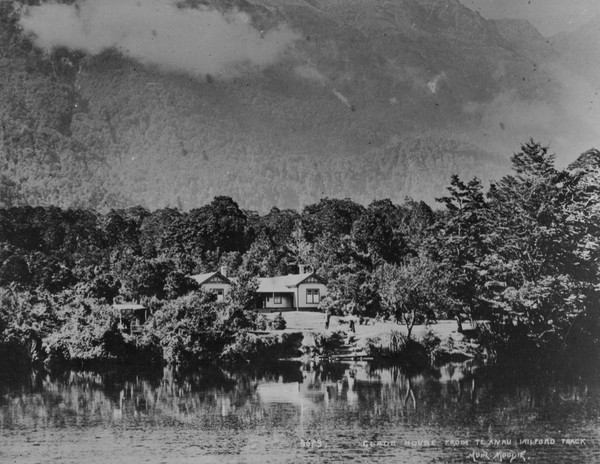 |
| Glade House prior to its destruction |
 |
| The Glade House fire in 1929 |
 |
| The modern Glade House as it exists today |
All that was left for the day was to be shown to our rooms before settling in for the first night on the MIlford Track. Don't let the sunny skies fool you, we'd be in for a little bit of everything as we embarked on the finest walk in the world. For Day 2 (Glade House to Pompolona Lodge), read on - this is the true start of the Milford Track, the valley narrows, the walls grow taller, and we get our first real taste of the Fiordland wilderness.

No comments :
Post a Comment